Guy

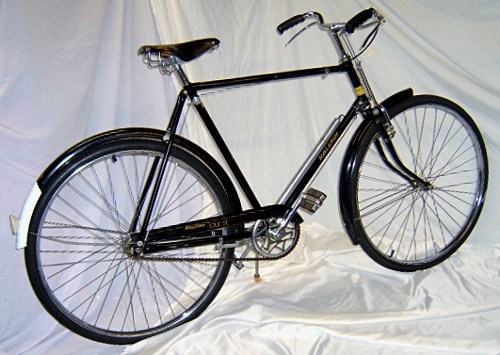
The Three-Speed

raleightourist_500

When I penetrated back to the day-room I encountered two gentlemen called Sergeant Pluck and Mr Gilhaney and they were holding a meeting about the question of bicycles.

"I do not believe in the three-speed gear at all," the Sergeant was saying, "it is a new-fangled instrument, it crucifies the legs, the half of the accidents are due to it."

"It is a power for the hills," said Gilhaney, "as good as a second pair of pins or a diminutive petrol motor."

"It is a hard thing to tune," said the Sergeant, "you can screw the iron lace that hangs out of it till you get no catch at all on the pedals. It never stops the way you want it, it would remind you of bad jaw-plates."

"That is all lies," said Gilhaney.

"Or like the pegs of a fairy-day fiddle," said the Sergeant, "or a skinny wife in the craw of a cold bed in springtime."

"Not that," said Gilhaney.

"Or porter in a sick stomach," said the Sergeant.

"So help me not," said Gilhaney.

-- Flann O'Brien, The Third Policeman (New York: Plume, 1976), 76.

The Brick Moon

If from the surface of the earth, by a gigantic peashooter, you could shoot a pea upward from Greenwich, aimed northward as well as upward; if you drove it so fast and far that when its power of ascent was exhausted, and it began to fall, it should clear the earth, and pass outside the North Pole; if you had given it sufficient power to get it half round the earth without touching, that pea would clear the earth forever. It would continue to rotate above the North Pole, above the Feejee Island place, above the South Pole and Greenwich, forever, with the impulse with which it had first cleared our atmosphere and attraction. If only we could see that pea as it revolved in that convenient orbit, then we could measure the longitude from that, as soon as we knew how high the orbit was, as well as if it were the ring of Saturn.

"But a pea is so small!"

"Yes," said Q., "but we must make a large pea." Then we fell to work on plans for making the pea very large and very light. Large, -- that it might be seen far away by storm-tossed navigators: light, -- that it might be the easier blown four thousand and odd miles into the air; lest it should fall on the heads of the Greenlanders or the Patagonians; lest they should be injured and the world lose its new moon. But, of course, all this lath-and-plaster had to be given up. For the motion through the air would set fire to this moon just as it does to other aerolites, and all your lath-and-plaster would gather into a few white drops, which no Rosse telescope even could discern. "No," said Q. bravely, "at the least it must be very substantial. It must stand fire well, very well. Iron will not answer. It must be brick; we must have a Brick Moon."

-- The Brick Moon and Other Stories, by Everett Edward Hale